Wuff

Tuesday, February 26, 2008

house: interior feel

I don't have pictures of the inside of our house great enough to do it justice, but people keep asking and something is better than nothing. (You can read all my posts labeled "house" to read this together with other pictures.)

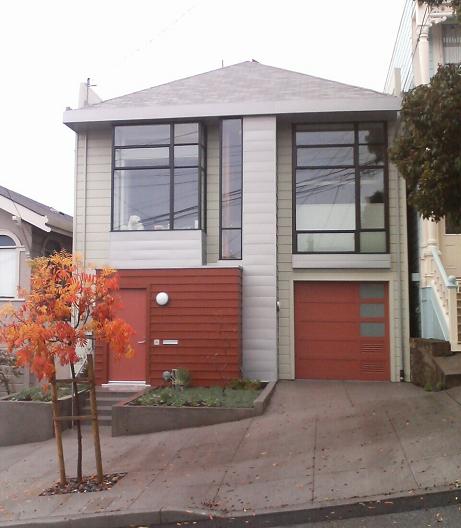
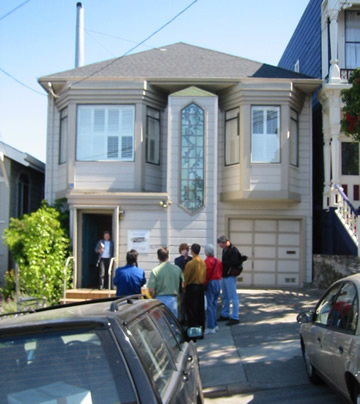
To get your bearings, once again here's the picture of the front of the house from my general post about the remodel. new house facade
The front window on the right is the office area (here's a close-up of the office). Note how the roof is hipped rather than an upright gable.

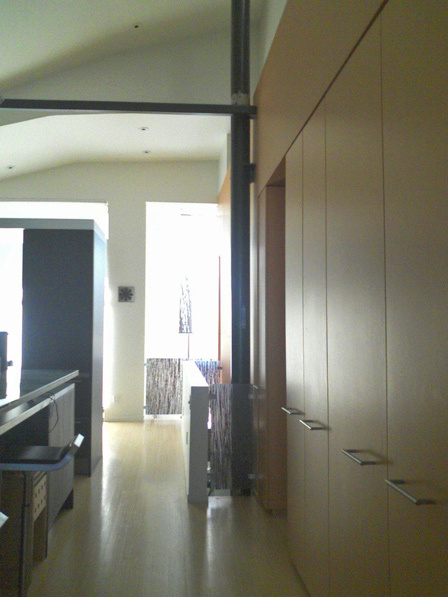
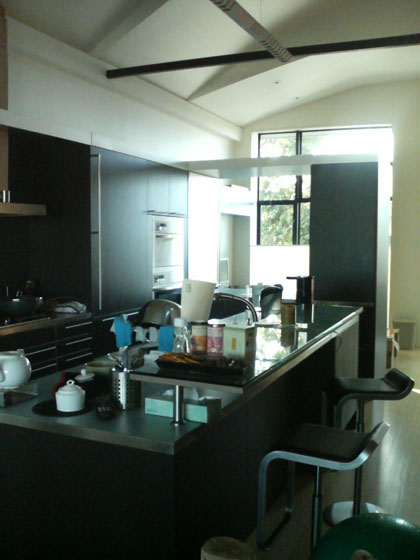
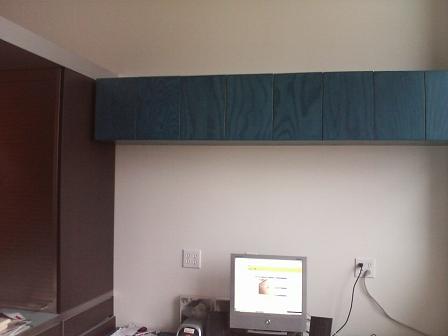
From the inside, here's a picture looking from the kitchen past our (messy) kitchen island towards that office window. kitchen looking through to office Ignore the bulthaup system 25 kitchen details for now and focus on the space above. Our old house had a double-height living space with a barrel vault ceiling over it, and we told Markoff-Fullerton Architects we liked it. So they and our structural engineer Mike Kaszpurenko of Structural Engineers Collaborative blew up most of the attic, removing all the rafters and beams, and under the roof created a rhythm of folded panels. You can see 2 ½ panels in that picture, the one closest to the window is lower to fit under the hipped roof. There's something about "space above" that is immensely satisfying, this house would be less with just 9-foot ceilings throughout. Initially I wasn't sure about Markoff-Fullerton's relatively complex handling of the ceiling, but without it the second floor would feel like a white barn (not that there's anything wrong with that); this design is substantially richer.
When you remove the roof beams, your house falls down, so that black steel beam in the picture is just part of the elaborate engineering to brace the house. (The silvery thing that seems to meet it is simply a fluorescent light hanging over the kitchen.) The office window has an up-down Hunter-Douglas Duette shade, in the picture its top is lowered to let light in while preserving privacy.

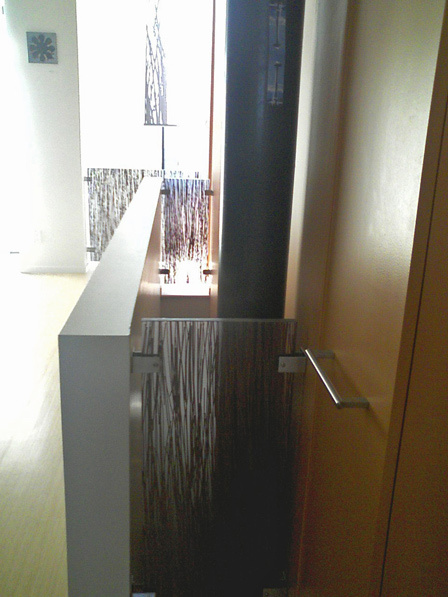
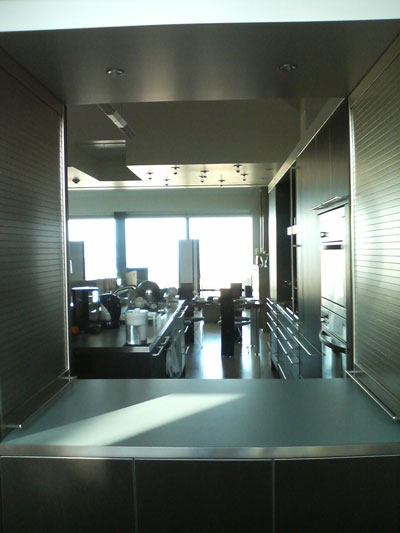
Here's a view the other way, from the office through to the kitchen, with the dining area and then the living room visible beyond.
looking through kitchen L
As you can see, this side of the house is a a straight uninterrupted shot from front to back: office-kitchen-dining area-living room, with no interior walls (requiring more structural engineering effort). The second-floor flooring is bamboo ply throughout. As always happens, the absence of walls makes spaces feel smaller than they really are.

The kitchen cabinets form a backwards 'L' shape around the kitchen island, and the part of the 'L' in the foreground forms a "pass-through" from the office to the kitchen. Its sides are two bulthaup appliance hutches with rolltop covers. Steve and Kai from bulthaup-SF at Limn did a great job working with M-F to design the kitchen, they spent two hours just finessing the problem of the corner where the casings meet in the 'L'. As the kitchen grew (the island is 10 feet long!) it shrank the office but it's the literal and figurative center of the house.

My post love handles has a close-up of the black stained oak of the kitchen and its immaculate handles. The gorgeous nordic blue kitchen counter material here and on the island is laminate. We read up extensively on the pros and cons of marble, granite, tile, sandstone, concrete, aggregate, terrazo, stainless, unobtainium, ... and laminate is definitely our favorite and most practical material. (That decision led to major "you can't be serious" attitude from superficial jerks at deluxe kitchen showrooms whose tiny minds can't disentangle wealth from marble counter tops.)

Unfortunately you can't see any of the folded ceiling panels in this picture. After the four variable-height folded ceiling panels over the office and kitchen you can see the ceiling drops down to a flat ceiling over the small dining area, punctuated by exposed bulbs and an access hatch to attic space above it. (All five segments are the same width—Markoff-Fullerton get details right) This is the lowest ceiling on the second floor and makes the dining area feel cozy despite being surrounded by space.

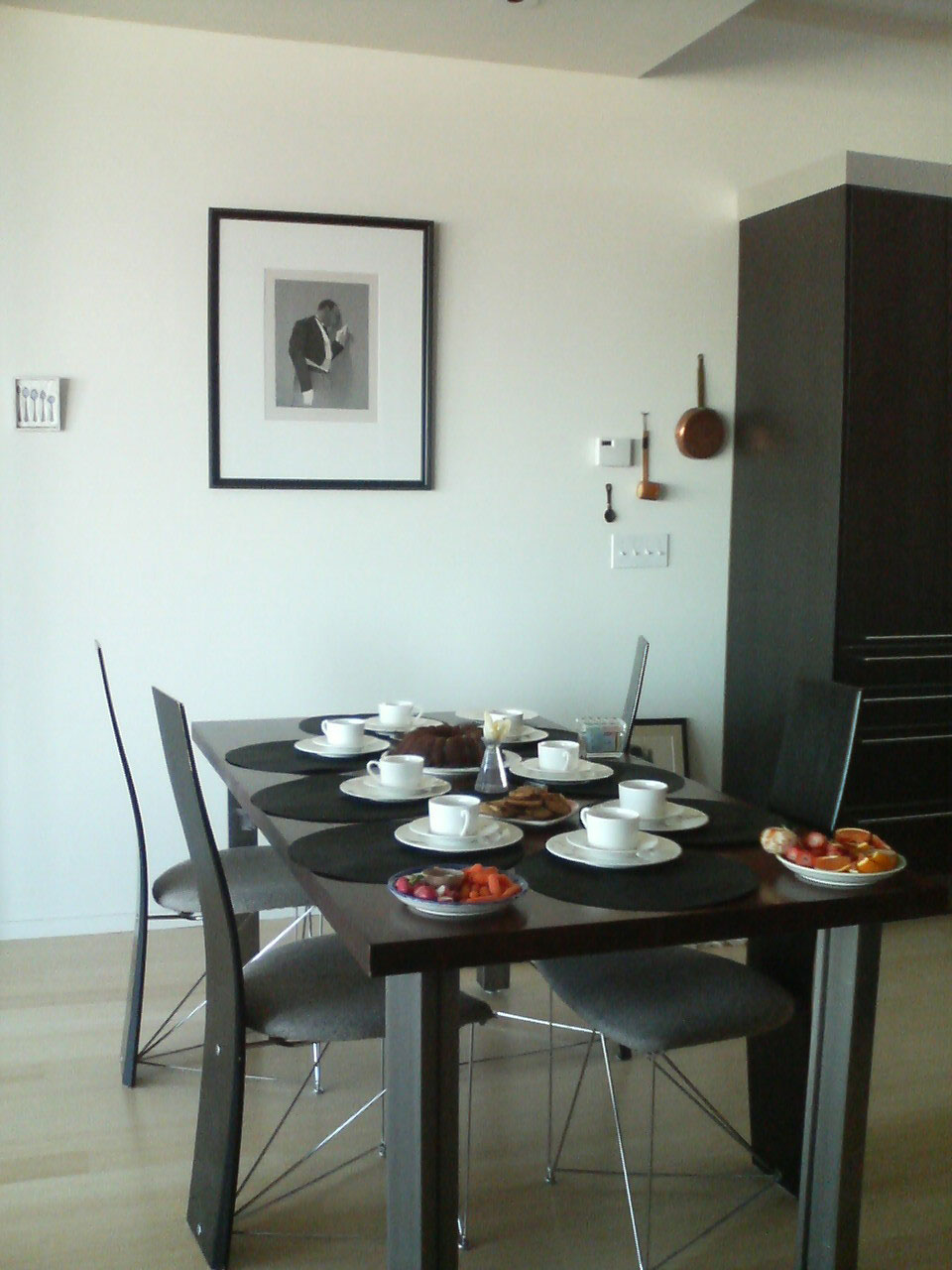
Here's a picture of that dining area. little dining area
It's a simple orderly space within the progression. The print on the wall is by Mark Stock, the tiny encaustic of the four spoons on the left is by Kelly Luscombe. Since this picture we switched back to a glass tabletop.

I've already shown pictures of the living room in stereo on and great media storage.

This is only one side of the second floor. The other side (bedroom-bathroom-stairs) is different and equally stimulating. It's hard to do the design justice in pictures, and they can't capture the changes as the sun moves and we adjust the shades and lighting.

Labels: , ,

Wednesday, December 13, 2006

house: front façade fixing

new house facade
This was a monstrous remodel to make a modern house.

Here's what it looked like before:
old house facade
Nothing much changed, it's still recognizably a two-story Edwardian with bedroom and office bay windows flanking an odd central "nose", with an entry way and garage below. It's still got wood siding and a hipped (i.e. tilted backwards, unlike a Victorian gable) composite roof. No wonder nobody complained during the permit review. But in fact everything changed:
  • new roof (the old one wasn't strong enough to cope with removing all the rafters and interior walls)
  • rebuilt entry "box"
  • moved garage opening
  • steel framing
  • parapets required for fire code
The house façade had interest, but if you look carefully, it sucked. Nothing lined up:
  • the left bay window hung over the side of the entry box
  • the right bay window was misaligned with the garage
  • the bay windows were different sizes
  • The center front staircase wasn't centered! Furthermore, the pointy stained glass and pointy roof were arrows shouting out "Hey, I'm over a foot off-center to the right"
Some of this is easy to fix, it just rip out and rebuild. But the last was hard, hard, hard to solve. Early in the design we moved the stairs back to the middle of the house, so we had some flexibility. But something had to go between the windows and we wanted to keep light in the front. Our architects Markoff-Fullerton came up with dozens of sketches organizing the four boxes (two windows, entry box, and garage) around the front, they tried extending planes from them like a Peter Eisenman construction, tried making the entry box and nose into a giant 'd' shape. Nothing quite worked. Then they came up with the idea of splitting the nose into partly glass and partly solid. The line between them is perfectly centered.

Unlike a usual McMansion remodel, our architects shrank the front: with the stairs moved to the inside of the house, the nose could shrink, and they pulled the right window back. The solution of the center problem and the stacking of the front four boxes around the nose to form planes of varying depths is a work of complete sustained artistry. Building a modern house from scratch in the middle of nowhere would be far simpler. Yet you'd never know to look at the house how much design effort went into it; our neighbors just like or love the house without really knowing why.

Other notes:
  • The material in the nose and below the windows is Rheinzink, a more environmentally benign material than galvanized zinc.
  • Building codes required lots of ventilation in the garage. Some day we'll swap out one of the vents for another translucent panel and the front will look even better.
  • The entry box was supposed to have a semi-solid golden stain, but it came out darker and then needed a second coat.
  • Elliot Goliger of Artisans Landscape did the front planters.
  • The street tree is a Chinese Pistache (first they made our toys, then our electronics, and now our trees...).
  • I blogged more on the front entry hardware.


,

Labels: ,

house: front detailing

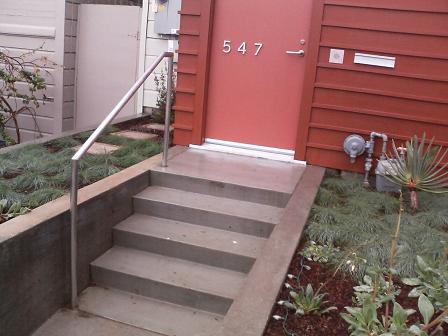
California Contract Co. handrail, Schlage L lock, Obline house numbers, Doorbell Fon, and mail slot
Handles meet up with accessories on the house front.

Note how the house numbers, door handle, doorbell, and generic mail slot are in a perfect line. Bruce Fullerton of Markoff-Fullerton really worked on the horizontal spacing, splaying the numbers across the door in a modestly strong way. I chose the house number font (Obline regular from customhousenumbers.com); unlike most modern fonts the '5' is upright and the '7' has a lovely subtle curve. The California Contract Co. hand rail, house numbers, and Schlage L mortise lock are all in satin stainless steel, but then the Door Fon and the mail slot are in brushed aluminum. If I had the money the finishes would all be identical; I'd also get the ugly gas connection and electrical meters hidden by any means necessary. Mies van der Rohe said "God is in the details", but God had time and money to burn.

, ,

Labels: , ,

Sunday, November 12, 2006

house: beautiful

Random guy on street: "That your house? It's beautiful"

Damn right it is. Thanks to us and Markoff-Fullerton Architects

More to come.

Categories: , ,

Labels: ,

Monday, September 18, 2006

architecture: Norman Foster on-screen and in Toronto

I saw Woody Allen's woefully underwritten Match Point and one of the characters works in "Norman's gherkin", the fabulous Swiss Re building. The movie's exterior shots obscure the building's seductive rounded bottom, so it looks like an obscenely phallic symbol on the skyline. But I've walked around it and it's so beautiful in its seamless idea->design->execution that it's unreal. The movie's interior shots show conventional rectangular offices walled off from the curving exterior, which if true is a shame.

I just learned from Wikipedia that stormin' Norman also designed a relatively modest University building that I enjoyed in Toronto. He's reliably fine and usually great.

Categories: ,

Labels: ,

architecture: Foster and others' buildings at 9/11 site

I heard that my hero Norman Foster has a building at the 9/11 site. As does his one-time partner Richard Rogers. Here's a nice set of photos of the site.

It's just a collection of skyscrapers, but they should turn out nicely, and the memorial sounds promising. Liebeskind's Freedom Tower feels the weakest of the buildings, but the devil is in the details.

I was fortunate to see the WTC towers shortly after they were built, when they were right on the waterfront before all the dull César Pelli towers in Battery Park City obscured them (see the before photo). They weren't lovely buildings, but very pure and the scale simply breathtaking.

The proposal to rebuild two towers there is touching, but the actual design for the rebuilt towers is hideous, losing the relentless endless columns of the original.

It's funny how the familes of victims feel they should get to choose the form of the buildings and the memorial. You're just minor stakeholders! This needs to be a historical site for the world.

Categories: , ,

Labels: ,