music: guitarist Steve Howe ignored

How can Steve Howe not be on the December 2010 Rolling Stone 100 Greatest Guitarists list? He was winning guitarist of the year polls throughout the 70s!! Even if you ignore his skills on classical, fingerpicking, flamenco, pedal steel, and slide (“Going for the One”!), his clattering wail solos put him on the list.

The fantastic interplay on the intro here shows his group skills (close your eyes and it’s almost an Allman Brothers Band jam) then the solo at 5:42, the building chorus at 6:20 into the bridge and then the liquid solo at 6:50 is phenomenal, then another killer at 7:35. And the same guy did the crazed genre-busting mashup on the jazz-rock “Sound Chaser”!

He was winning guitar polls throughout the 70s and now forgotten by the mainstream and the Rock and Roll Hall of Fame?! It’s insane. Rolling Stone writer David Fricke put him at 69, but they polled a lot of musicians as well.

Posted in music | 2 Comments

architecture: fixing SFMOMA

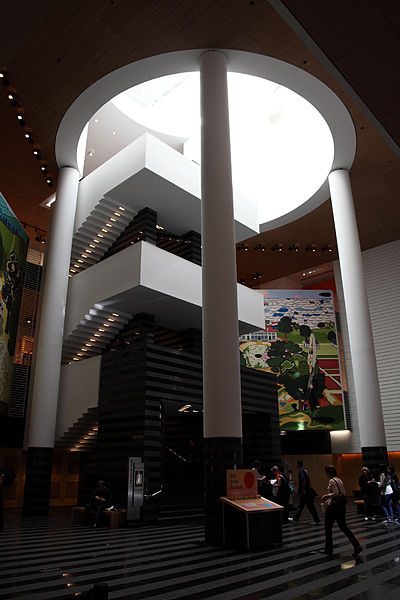
It’s sad when an architectural statement falls short. San Francisco Museum of Modern Art hired Mario Botta for their new building in 1994 and undoubtedly hoped they’d get a statement building from an up-and-coming starchitect. It turns out he ripped off the sloping stack atop the atrium from his own earlier design, the planned ring of trees on it was never practical, and his atrium below that stack is a dark, low-rent uninspiring place.

San Francisco Museum of Modern Art, interior staircase

original atrium and staircase

Really good architects can work with what exists and make it better, sometimes all that blather about “engage with the skyline that surrounds it. Its sculptural identity is found in a formal language that embraces and invites the silhouettes of its neighbors to participate in the dialogue of the new urban identity” actually means something. In this case it looks like up-and-coming starchitects Snøhetta may have figured out how to fix the bad Mario Botta design with their massive expansion:

The design of the interior spaces synthesizes the current Mario Botta-designed building and the new Snøhetta expansion into one seamless whole … To create an expansive, flowing space on the entry level of the museum, the original staircase will be removed from the Botta atrium.

In other words, junk that stupid ugly staircase peering out on the cheap siding lining the dull box of the original atrium

The sketches look good, and Snøhetta’s Oslo Opera House  is really great. The huge expansion will incorporate the Doris and Donald Fisher Collection (they planned their own museum in the Presidio, NIMBY types stopped it, then Don Fisher died), including Richard Serra’s sublime sculpture “Sequence”. The exterior has a New Museum (Sejima + Nishizawa/SANAA) Herzog/de Meuron vibe; we’ll see how badly San Francisco planning paralysis and special interests will screw it up.

Posted in architecture | Leave a comment

computers: browser-based efforts

I wrote a year ago that when it comes to computers, I want to be browser-based — since I’m doing most of my work in the browser, let me do nearly all my work in the browser.

Boot 2 Gecko

Mozilla agrees, and they’re working on the poorly-named B2G (“Boot 2 Gecko“) project “to pursue the goal of building a complete, standalone operating system for the open web.” Yee-haw! But it’s initially targeting smartphones, and will use the Android lower layers to boot the device. They have to start somewhere, and providing an alternative to silly app stores selling hundreds of thousands of apps that do little more than connect you to an information provider (which is what the web does!) is worthwhile. But that’s not what I had in mind as a replacement for my desktop!

I tried a couple of alternatives.

Jolicloud

Jolicloud is a web-based desktop and app launcher, and you can also run it from a dedicated Linux distribution called Jolicloud OS. It’s OK, but the web-based part isn’t that good. For example, in its app window, if you click the (i) icon to get info about an app, you can’t use the browser’s back button to go back to the app window. Instead it stupidly adds its own [Back] button. The “apps” are actually just web sites, which in some cases is reasonable; but many of them require you to register and get a login, and Jolicloud seemingly does nothing to share a username or OpenID between them all. If I want to make a note, don’t send me to a web site, provide me some intelligent browser-based HTML code that works offline.

BrowserLinux

I downloaded BrowserLinux and ran it in VirtualBox, i.e. I simulated running it on my computer. It’s based on Puppy Linux which is a fine and lightweight Linux distribution, and it provides a working Firefox, but its handling of local files is weak. Despite the name, it doesn’t use the browser for many tasks. E.g. If you click on an image, it tries to run the mtpaint program, even though Firefox itself can preview images.

This is a common failing of Linux distros. They don’t seem to distinguish opening a file in order to look at it and opening a file to in order to edit it, the way Windows’ context menu can. The browser can view all kinds of files, but in many cases it can’t edit them. I don’t know if the XDG specifications distinguish the two operations. The programs that BrowserLinux provides — ROX filer to show files, Alsaplayer to play songs — are lightweight, but have zero consistency with each other, let alone the Firefox browser. BrowserLinux is just a lightweight Linux distro for older machines that puts the Firefox icon on its desktop without rethinking the rest of your computing activities so that you do them as much as possible in the browser, either with local HTML, remote web sites, or browser extensions.

I really want to try ChromeOS to see how Google handles things, but as I remarked earlier, Hexxeh’s ChromiumOS builds require fancy graphics.

Posted in software, web | Leave a comment

cars: progress in eco, not in design

I went to the local auto show, a low-key affair compared with the Los Angeles one. Mercedes-Benz, smart USA, and Suzuki skipped it altogether, and there were no new reveals.

Fuel efficiency

Toyota will be on a fuel efficiency warpath throughout 2012. The Prius v small van (44 city / 40 highway mpg) is already showing up at dealers, next the Camry Hybrid (43/39) retakes the “midsize car with a trunk” (for people who don’t like the Prius look) crown from the Ford Fusion Hybrid, next the Prius Plug-in Hybrid (100+ mpg if you drive less than ~20 miles, around 60 mpg if you drive further), and then the Prius c compact car (?? 53 mpg?). The last one will finally reapply the laws of physics to gasoline-powered cars; since Honda killed the original Insight 5 years ago, you can buy a smaller car than the Prius, but in exchange for less room and a less powerful engine you get significantly worse mpg. The 2011 Prius gets 51/48 mpg, astounding for a practical reliable midsize car.

No small fuel-efficient all-wheel drive car

Unfortunately Toyota makes nothing for me, none of these are compact all-wheel drive snow cars. The Highland Hybrid gets 28/28 mpg which is fantastic for a 3-row SUV, but way too big. Nobody else is doing much better since I wrote 4×4 x zero 6 years ago: Audi’s A3 TDI isn’t available with AWD, the new Ford Escape won’t offer a hybrid variant and the Ford C-Max hybrid and C-Max Energi plug-in hybrids (not at the show) won’t have AWD. Supposedly Toyota will bring out the RAV4 Electric (not at the show) in 2012 with powertrain by Tesla, but it’s a beefy SUV and unlikely to be practical to drive to Tahoe. The chunky Mini Clubman is very roomy for its short wheelbase thanks to its height, but 25/31 mpg is lame. As no one is making a small AWD hybrid, the best replacement for my aging Subaru is likely to be the new Subaru Impreza, which thanks to a smaller engine and a Lineartronic CVT gets an impressive 27/36 mpg; it’s nice to see Subaru finally offering “premium” features on its small car like leather, heated seats and mirrors.

Speaking of plug-in cars…

  • The Chevrolet Volt plug-in hybrid is a nice car, great as your only car if your regular commute is ~40 miles, but it doesn’t feel like a $39,145 sedan.
  • the Mitsubishi i-MiEV is a quirky small car, just needs to be cheaper
  • the Nissan Leaf was everywhere and they had a fleet you could drive indoors (no emissions!). It feels big and spacious inside and so distinctive.
  • BMW had its lease-only 1-series ActiveE electric car, but the Leaf makes all the “give us $500/month to lease one of a few hundred trial cars” pointless and irrelevant. There was no sign of their innovative i3 and unbelievable i8 future plug-in cars at the show.
  • the Ford Focus Electric was spinning on a stand but you couldn’t open its trunk to see its space-robbing battery pack. At $40,000 it’s way overpriced compared to the Leaf.
  • there was one Fisker plug-in hybrid, an enormous 5,400lb yacht with massive presence

Styling from the past

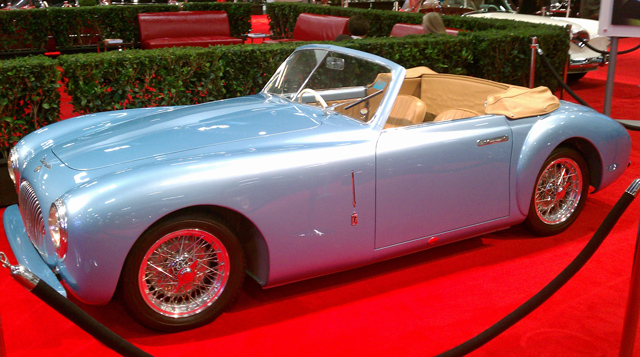
As for styling, Prius wins for being so aerodynamic, otherwise cars were treading water which means Hyundai and Kia’s handsome-enough models will continue to steal sales. For some reason the Academy of Art had a huge stand showing its classic car collection (do the hordes of would-be artists that it buses around San Francisco know their tuition fees are paying for this?!) and the old cars destroy the new ones. Only Cadillac and Jaguar’s present-day sedans come close to the panache their old cars had. Some classics were so beautiful, like a darling 1947 Cisitalia (one of Battista "Pinin" Farina’s first designs):

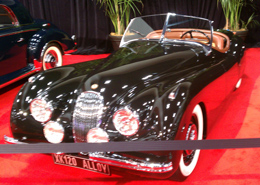
and the luscious front and sides of the 1948 Jaguar XK120.

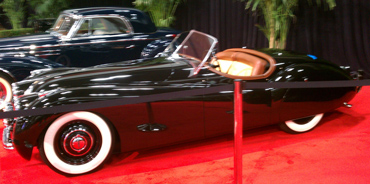
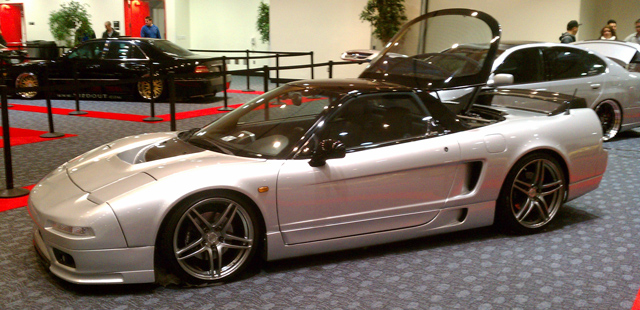
There was also an “aftermarket alley” with tuner cars, most with oversized wheels splaying out from lowered suspensions that look like comic drawings (look at the wheels on the car in the top-right background below). Don’t try to fit snow chains on them! They had a nice series of Nissan Skyline GT-Rs, I didn’t realize it first came out in 1969. Here too, the oldies were better, particularly the Honda/Acura NSX, looking beautiful and purposeful 21 years later.

Posted in cars, design, eco | Leave a comment

music: Jeff Beck grinds cats

I watched Jeff Beck: Performing this Week… Live at Ronnie Scott’s, and I’m hugely impressed but not quite thrilled. The man doesn’t play guitar, he plays Stratocaster; the whammy bar and volume knob are integral to his right hand technique and it’s great to watch.

Vinnie Colauita is phenomenal on the drums and 21 year-old Tal Wilkenfeld is impressive, but they don’t quite jell. I would love to hear the band with Pino Palladino on bass.

Beck plays a lot of jazz-rock fusion at various tempos, including a tune from John McLaughlin, the master of it (Mahavishnu Orchestra’s drummer Billy Cobham vs. Colauita, tough call). Throughout he wills an angry screaming tone out of his guitar but ultimately I find it wearying. Eric Clapton comes out and you realize there’s no jangle in Beck’s playing.

It’s cool to see where Steve Howe got so many of his ideas. Many of the guitar parts on Relayer sound so similar, screaming yawl vs. clattering wail, tough call but Howe is a far better composer and musician. Beck is riff-tastic but almost funk-free (compare with the awesome John Mayer Trio).

Standouts: Cause We’ve Ended As Lovers (with a fine bass solo) and Nadia.

Posted in music | Leave a comment

music: Quincy Jones on respecting musical styles

I borrowed Q on Producing from the library. As the pretentious banner “THE QUINCY JONES LEGACY SERIES” across the top hints, it’s terrible, sycophantic hagiography woefully short on details of actual music production. But there are a few nice quotes. Around age 15, Quincy Jones was in a band playing any gig that paid, and

We used to try to make the schottisches and bar mitzvah music, like “Eli Eli” and stuff, sound like bebop in Seattle, but Ray [Charles] would say, “Goddamit, don’t! Play it true to the spirit of the music! Let each song have its own soul—its own truth.” That was the best advice. Ray was only two years older than me, but he was like a hundred years smarter. … If you’re true to it, each style of music has its own spirit and it deserves the dignity of having its own space.

As opposed to the less inclusive approach…

Elwood: What kind of music do you usually have here?
Claire: Oh, we got both kinds. We got country *and* western.
Posted in music | Leave a comment

computers: reporting bugs in a sea of versions and projects

Someone’s post When is a bug report useful? inspired me to comment. I have two great ideas in here

  1. bug systems should be aware of my distribution, version, and related packages
  2. software projects should provide a way to test drive the latest version

Good points. But everything breaks down with “It should be about the most recent version available”. (K)ubuntu doesn’t ship the most recent version available!

For reporting, what would be great is if the bug ecosystem was both version- and distribution- aware. I should be able to search for a bug, and even if it’s fixed find relevant bug reports because it still applies to my version and/or distro. Ubuntu’s Launchpad tries to handle this with its “(+) Also affects project (+) Also affects distribution” and upstream linking, but in my limited understanding their implementation creates another fjord in which tens of thousands of bugs languish underwater. The problem also goes in the other direction: these days if you Google for problems with any Linux feature or program, the top search results are invariably cluttered with detailed bug reports and forum threads about Ubuntu 8.04 and Fedora 9… from 2008.

Another issue with reporting is the interconnected layers in any modern Linux distro. My problem “KDE System Settings picks the wrong sound card” turned out to be PulseAudio providing identical description strings for them (“Internal Audio Analog Stereo”) because the kernel’s PCI probing is messed up on my hardware, with a workaround that requires Alsa config file changes. Likewise my problem “Firefox prints blank images” turned out to be bugs in the interaction of Ghostscript and libpoppler exposed by Ubuntu’s configuration of CUPS to still use a PostScript workflow even when apps generate PDFs for printing. Both involved four or more web sites, four bug systems, four wikis, and four forums to wander around in after looking in my distro’s bug system. Many people would call this the typical Linux clusterf*** and give up in despair, but it shows that bug systems have to become smarter about relationships.

In order to reproduce a bug with latest version, if I’m lucky I can download a standalone nightly binary from the project, unpack it into a test directory and retest with that. If I can’t, then sometimes I can switch my package manager to install unstable packages, but often that has cascading dependencies that require updating half a dozen other packages to unsupported latest. I’ve had problems with VLC and Wine and Pulseaudio and no easy way to try the latest short of compiling from source or installing a rolling bleeding-edge distro in a VM.

Here’s an idea: what if projects provided a runnable version of their nightly build? Each could have a test server with compiled code and you could either use X’s DISPLAY to have the remote binary display on your screen, or you could use a remote desktop protocol, some of which can even run in a browser. This “Try the latest” facility could take screenshots and link to bug reports. And imagine how many more people would use your cool program if they could test-drive it!

I really appreciate anyone who triages bug reports in the current situation, it’s a tough mission.

Posted in open source, software | Leave a comment

cars: 1990s slant-nose beauties

I’ve seen a few Ferrari 458s on the road. It’s a strange, intense-looking car in person. In a debate on its beauty someone brought up the Ferrari F355.
Ferrari F355 Spider

For sure the F355 is a beautiful car. It’s such a smooth clean joy to behold. No grille, and no headlamps! (Nowadays, any car that’s not a sports car has a stupid non-functional shiny grille between the headlights, and every car has vast elongated headlights.) I love the F355 so much I bought three — Hot Wheels 1:64, Hot Wheels 1:18, and the Barbie radio control model that can only drive straight or reverse in a circle. (Whenever I meet Ferrari owners I ask if their F355 has the same steering problem, and if its mirrors fall off like mine.)

However, from that front angle, and only from that angle, the Lotus Elan (the ’90s M100 version) looks even nicer.
Lotus Elan (M100)
(dave_7’s Flickr photo)

The Elan was petite and thus light, and some say it’s the finest-handling front-wheel drive car ever made. But it was expensive, especially compared to the nostalgic retro Mazda Miata that launched at the same time.

Posted in cars, design | 1 Comment

How to”sign” documents so you can junk your Fax machine

Fax machines use a terrible scanner to send a grainy image of a page down a phone line, it’s last century’s technology that needs to die. And what is on that page? 99.7% of the time, it is something that was generated by a computer!

The main reason people think they need a fax machine is to sign documents, “please sign this form and fax it back to me.” But your signature on the document is just more grainy dots going over the phone line. Instead, add the pixels digitally: place a transparent image of your signature on top of an electronic document, and e-mail or upload that. Here’s one recipe.

First scan your signature.

  • On a white sheet of paper, sign your name in black ink
  • Scan it into your computer as a grayscale high-res (300 or 600 dpi) image. If you can, use your scanner options to
    • only scan the rectangle surrounding your signature
    • reduce grain (don’t scan the paper’s texture)
    • adjust the lightness/darkness (to pick up the signature and not smudges)

Make your signature into a transparent grayscale image

For the signed page to appear realistic and not like a glued-together ransom note, you need to blend the signature on top of whatever’s below (unless you can always squeeze your signature to fit in a white area). So you want to make the white pixels of your scanned signature transparent, but don’t want jarring transitions from black signature to image underneath. You could probably get the free open source ImageMagick command-line convert.exe tool to convert whiteness to transparency. Instead I used Photoshop Elements, at which I’m far from expert, to delete white areas; similar steps should work in free image editors like GIMP and maybe Krita.

  • Acquire the scanned image.
  • If you didn’t earlier, crop the scan to your signature, convert to grayscale (not sure how).
  • Zoom in until your signature fills the window.
  • Choose the magic selection tool, set feathered edge and anti-alias.
  • Click outside of signature, it should select all the surrounding whiteness.
  • Press [Delete] and the white should go transparent, showing the checkerboard pattern.
  • Click areas of white inside the signature (e.g. inside the loop of an ‘o’ or ‘e’), and press [Delete]. You can set Photoshop Elements so clicking adds to the selection and thus click several areas before  delete, or do it piece by piece.
  • You want to end up with an image that has the mostly-black of your signature and everything else transparent.
  • Save as a grayscale PNG file with transparency (alpha)  as Your_name_sgn.png
  • As a check, you ought to try overlaying the PNG file over a color gradient, to make sure it looks plausible — no white areas, no blocky dots, etc. — but I fumble around in image programs, so… ahhh screw it.

Placing your signature on files

Then, any time you need to “sign” a document, just place your signature image on top and save it as PDF. If you’re writing the document yourself, you can do something like Insert > Image > From file… , choose Your_name_sgn.png, move it, resize it, etc. (that’s in the free and open-source LibreOffice Writer program).

But most likely someone sent you a PDF or you downloaded it, and you need to put your image on the PDF. I found Photoshop Elements sucks at this. It’ll import a PDF, let you place your signature, and save as PDF, but it converts the whole page to pixels, so the signed PDF becomes a huge file whose text you can’t search or select.

Instead, put your signature on the PDF with the mighty free and open-source Inkscape drawing program.

  • File > Open the PDF.
    • if it has multiple pages, choose the one page you need to sign
    • Import text as text
    • don’t check Replace PDF fonts with installed fonts (?? I’m not sure about this)
  • File > Import…, choose Your_name_sgn.png.
  • Drag it into place, then grab a corner handle and holding down Ctrl (to constrain it so it doesn’t squeeze and stretch), resize it to fit. Because your signature is transparent, it can overlap text and lines.
  • View > Zoom > Zoom In to make sure your signature looks plausible — no white areas, no blocky dots, etc. If it doesn’t, you probably need to go back into an image editor to edit the  Your_name_sgn.png image.
  • File > Save As… , choose Portable Document Format (pdf), with options something like:
    • Don’t Convert texts to paths (you want the text to be selectable)
    • Use 300 dpi resolution for rasterization (? not too blocky)
    • Export area is page
  • With any luck, the resulting signed.pdf will be small, searchable, selectable, and look like you signed it.  Now you can e-mail or upload it.

Unsigned thoughts

Disclaimer: IANAL, I don’t know or care if this counts as a valid legal signature; it just looks like one.
Of course, if you can do this, anyone who has ever taken a credit card slip from you can do it too. A signature image on an electronically-transmitted document is worthless as proof of anything except “someone somewhere made an effort”. What we really need is electronic signatures. In essence, you transform the PDF file in a manner that only someone who has the private key for “S Page” could perform. It’s complicated but fantastically worthwhile. We’ve had the technology for years to create digital files and sign them to indicate “This must have come from person X” and/or  encrypt them so “This can only be read by person Y”; and combining them lets you do things like “This digital token is certified by Bank A to represent $217, and it came only from X and is intended only for Y.”

Cheers,
enjoy!
Posted in software | 2 Comments

movies: recent Woody Allen

Woody Allen’s recent Midnight in Paris is a fun trifle, stroking the audience’s ego with its 1920s Paris fantasy imagined by an intellectually lightweight author. Literally nothing’s at stake in this well-fed easygoing fantasy. It’s an echo of the far better, wonderful and sad Purple Rose of Cairo (also with a character named Gil!) released in 1985 (more proof that 1984 is the high point of Western civilization). It inspired me to rent all the Woody Allen movies I’ve missed. I’ve seen over 25 but his output is relentless, a movie every year for decades.

Even his recent misses are well-written, well-structured, well-paced. In some ways they don’t add up to anything, just urbanites talking, but perhaps because of his age Woody Allen is starkly laying out his philosophy which is that nothing adds up to anything anyway, so a pointless movie advances his argument.

You Will Meet a Tall Dark Stranger has great actors play a bunch of people deluded about love and the paranormal. (This after so many of his Mia Farrow-era movies are about strange and mystical goings-on.) The acting is fantastic, the observations droll, the unhappy marriage scenes are sensational. But then it just ends, leaving everything including a casually great plot twist/comeuppance (I had to pause the movie while laughing out loud in admiration) unresolved. The narrator helpfully explains that as Shakespeare (actually Macbeth) says, “life is a tale told by an idiot, full of sound and fury, signifying nothing.”

Whatever Works has a bunch of aging thinkers and young romantics and formerly religious find romantic fulfillment, then at the end Larry David as Allen’s mouthpiece turns to the camera and says

I happen to hate New Year’s celebrations. Everybody desperate to have fun. Trying to celebrate in some pathetic little way. Celebrate what? A step closer to the grave? That’s why I can’t say enough times, whatever love you can get and give, whatever happiness you can filch or provide, every temporary measure of grace, whatever works. And don’t kid yourself. Because its by no means up to your own human ingenuity. A bigger part of your existence is luck, than you’d like to admit

Posted in movies | 1 Comment